Início
3,1%
Conversion Rate
+2,3x
ROAS
+29%
Average Order Value
-40%
Repetitive Questions
De 1–2 vendas/dia para 4–6 com R$100
De 1–2 vendas/dia para 4–6 com R$100
E-commerce de joias que aumentou o ROAS em 121% por meio de reposicionamento estratégico, otimização do checkout e CRM. Do zero ao break-even em 18 meses.
E-commerce de joias que aumentou o ROAS em 121% por meio de reposicionamento estratégico, otimização do checkout e CRM. Do zero ao break-even em 18 meses.
3.4%
Taxa de Conversão
+2.3x
ROAS
+29%
Ticket Médio
MEU PAPEL
Tudo, de ponta a ponta.
Tudo, de ponta a ponta.
Fundador e operador
Product designer (branding, UX, UI, CRM)
Analista (GA4, Hotjar, Stripe, Meta Ads)
Atendimento ao cliente (WhatsApp, e-mail, chat)
Colaborações:
Colaborações:
Agência de tráfego pago: reuniões semanais, alinhamento criativo
Designer gráfico: rebranding (eu fiz o briefing, ele executou, decidimos juntos)
Influenciador: freelancer, reuniões semanais sobre conteúdo e criativos no Instagram
Devs da Nuvemshop: suporte técnico ocasional
Agência de tráfego pago: reuniões semanais, alinhamento criativo
Designer gráfico: rebranding (eu fiz o briefing, ele executou, decidimos juntos)
Influenciador: freelancer, reuniões semanais sobre conteúdo e criativos no Instagram
Devs da Nuvemshop: suporte técnico ocasional
FERRAMENTAS
Design: Photoshop
Analytics: GA4, Hotjar, Meta Pixel
Plataforma: Nuvemshop (limitada, mas funcional)
CRM: ActiveCampaign, WhatsApp Business, Chatra
Pagamentos: Nuvem Pago, Stripe (Pix, cartão, parcelamento)
Ads: Meta Ads (Facebook/Instagram)
Design: Figma, Photoshop
Analytics: GA4, Hotjar, Meta Pixel
Platform: Nuvemshop
CRM: ActiveCampaign, WhatsApp Business, Chatra
Payments: Nuvem Pago (Pix, card, installments)
Ads: Meta Ads (Facebook/Instagram)
Design: Photoshop
Analytics: GA4, Hotjar, Meta Pixel
Plataforma: Nuvemshop (limitada, mas funcional)
CRM: ActiveCampaign, WhatsApp Business, Chatra
Pagamentos: Nuvem Pago, Stripe (Pix, cartão, parcelamento)
Ads: Meta Ads (Facebook/Instagram)
TIMELINE
18 meses (maio 2023 – nov 2024)
18 meses (maio 2023 – nov 2024)
STATUS
Projeto concluído, loja encerrada
Projeto concluído, loja encerrada
VISÃO GERAL
VISÃO GERAL
Essavie foi uma marca DTC de e-commerce de joias em prata 925 que fundei e operei de mai/2023 a nov/2024.
Essavie foi uma marca DTC de e-commerce de joias em prata 925 que fundei e operei de mai/2023 a nov/2024.
O PROBLEMA
O PROBLEMA
Baixa conversão apesar de tráfego qualificado
Usuários viam o produto, hesitavam e abandonavam
Checkout confuso
Ansiedade pós-compra
Posicionamento de marca incorreto
Baixa conversão apesar de tráfego qualificado
Usuários viam o produto, hesitavam e abandonavam
Checkout confuso
Ansiedade pós-compra
Posicionamento de marca incorreto
O QUE EU FIZ
O QUE EU FIZ
Reposicionei a marca de “luxo tradicional” para “luxo acessível”
Redesenhei a landing page focando no produto herói
Otimizei o checkout com testes A/B
Construí CRM pós-compra
Reposicionei a marca de “luxo tradicional” para “luxo acessível”
Redesenhei a landing page focando no produto herói
Otimizei o checkout com testes A/B
Construí CRM pós-compra
RESULTADO
RESULTADO
Escalou de 1–2 para 4–6 vendas/dia, atingiu o break-even e decidi pausar quando a economia unitária mostrou que eu precisaria de capital (R$100k) para escalar.
Escalou de 1–2 para 4–6 vendas/dia, atingiu o break-even e decidi pausar quando a economia unitária mostrou que eu precisaria de capital (R$100k) para escalar.
O Problema
O Problema
Usuário
Usuário
Falta de confiança, medo de golpe e percepção de que “barato = falso”.
Falta de confiança, medo de golpe e percepção de que “barato = falso”.
“Isso é prata de verdade ou bijuteria?”
“Isso é prata de verdade ou bijuteria?”
“Vocês têm loja física? Alguém realmente já recebeu?”
“Vocês têm loja física? Alguém realmente já recebeu?”
“Por que é tão barato?”
“Por que é tão barato?”
Negócio
Negócio
Aumentar conversão e ticket médio sem aumentar o orçamento de anúncios.
Aumentar conversão e ticket médio sem aumentar o orçamento de anúncios.
0,7% de conversão na landing page (abaixo da média de joias)
0,7% de conversão na landing page (abaixo da média de joias)
Alto abandono no checkout (1,9% de conversão)
Alto abandono no checkout (1,9% de conversão)
Ticket médio mediano (R$198)
Ticket médio mediano (R$198)
Pouca recompra (8% em 30 dias)
Pouca recompra (8% em 30 dias)
100% dependente de tráfego pago
100% dependente de tráfego pago
Solução (O que eu fiz)
Solução (O que eu fiz)
Dividi em 4 frentes:
Dividi em 4 frentes:
1. Reposicionamento de Marca
1. Reposicionamento de Marca
Mudei de “luxo tradicional” (competindo com Vivara/Cartier) para “luxo aspiracional acessível”.
Mudei de “luxo tradicional” (competindo com Vivara/Cartier) para “luxo aspiracional acessível”.
O que mudou:
O que mudou:
Nova identidade visual (minimalista, sofisticada)
Novo naming: Estavie Jewelry → Essavie Joias
Copy focada em autoestima e aproveitar o presente
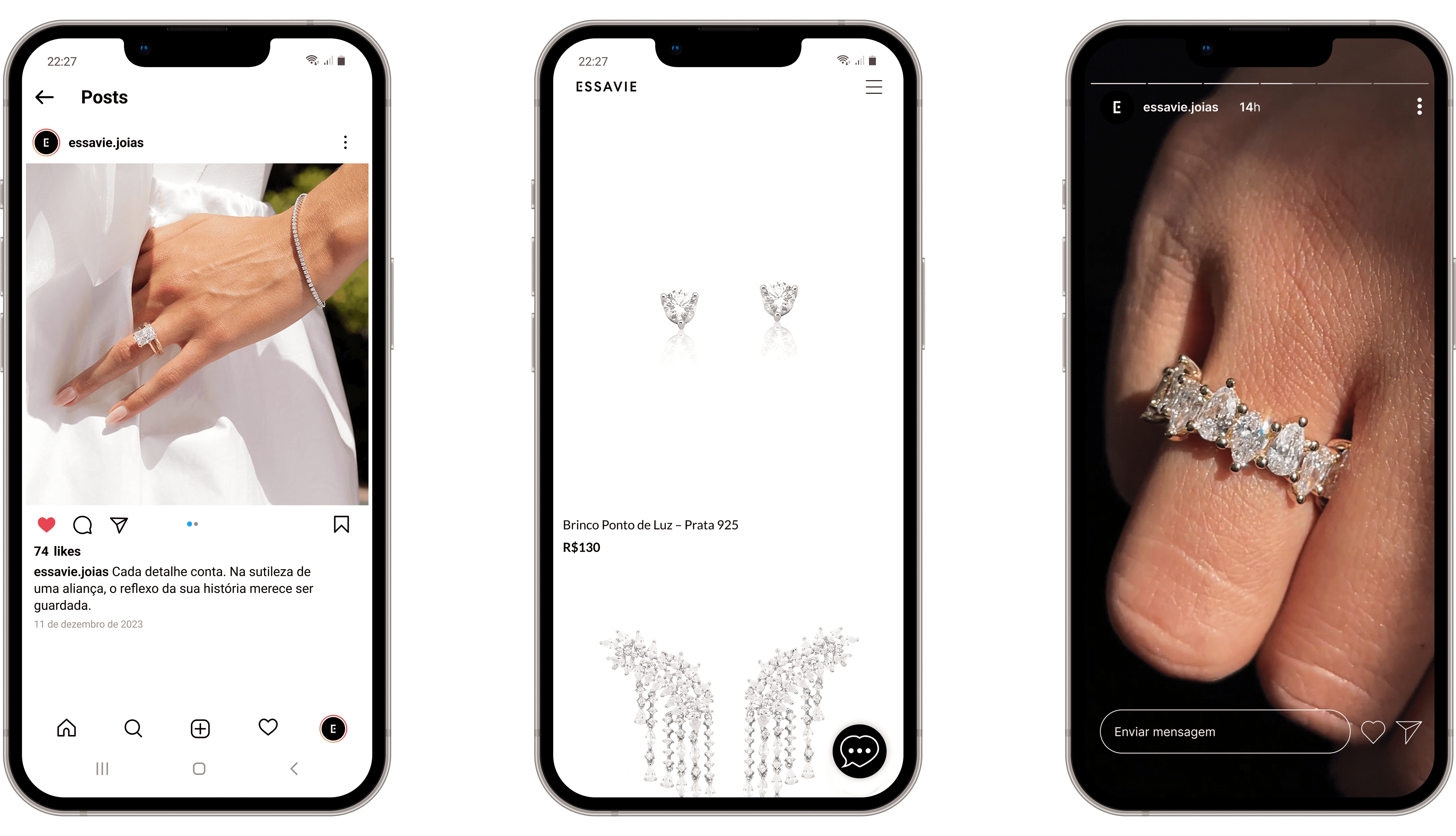
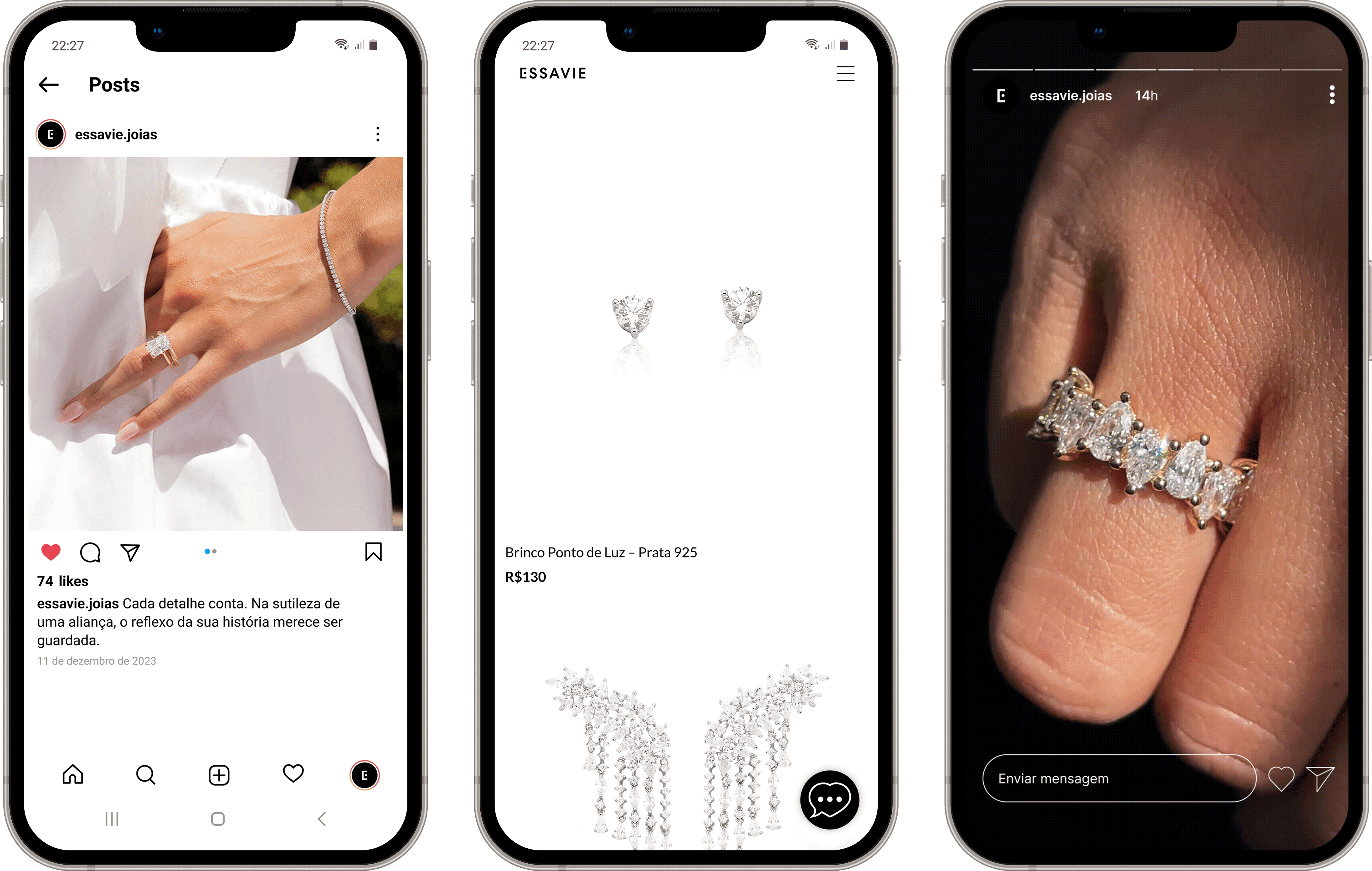
Fotografia que fazia a prata parecer ouro branco
Nova identidade visual (minimalista, sofisticada)
Novo naming: Estavie Jewelry → Essavie Joias
Copy focada em autoestima e aproveitar o presente
Fotografia que fazia a prata parecer ouro branco
Resultado:
Resultado:
+200% de conversão na landing page (0,7% → 2,1%)
+200% de conversão na landing page (0,7% → 2,1%)


2. Landing Page de Produto Único
2. Landing Page de Produto Único
Criei uma página dedicada ao produto vencedor (mais vendido, maior margem, menor taxa de devolução).
Criei uma página dedicada ao produto vencedor (mais vendido, maior margem, menor taxa de devolução).
Decisões:
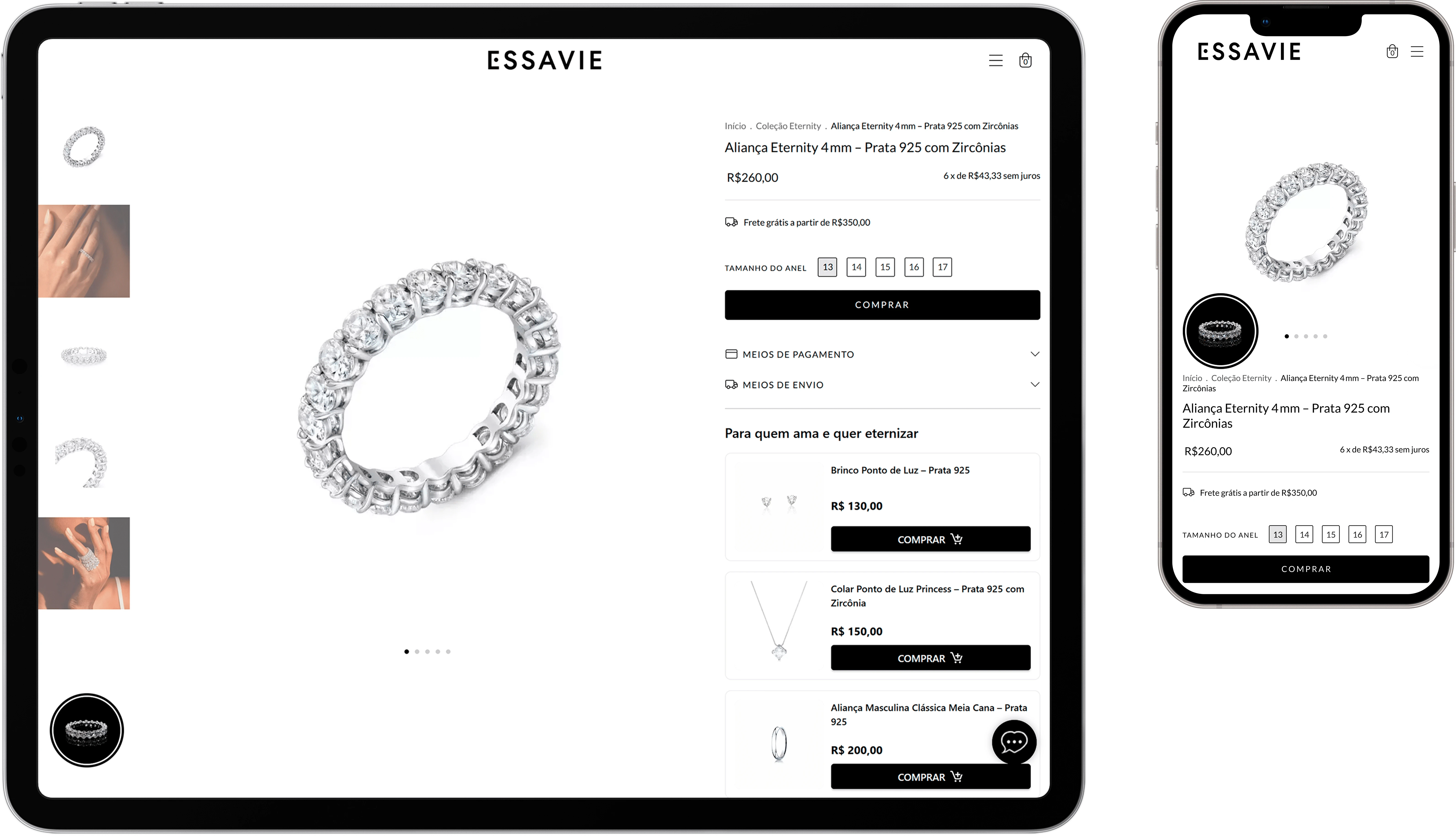
Image hero em fundo branco + fotos lifestyle/casamento
Preço e parcelamento acima da dobra
CTA direto: “Comprar” (não “Adicionar ao carrinho”)
REMOVIDO: avaliações de clientes (teste A/B indicou impacto negativo na percepção de qualidade)
Teste A/B de CTA:
“Comprar” (abre o carrinho) → 3,4% de conversão, R$256 de ticket médio
“Adicionar ao carrinho” (notificação) → 2,1% de conversão, R$268 de ticket médio
Escolhido: “Comprar” (impulso > chances do usuário adicionar outro produto ou abandonar o fluxo)
Resultado:
3,1% de conversão final
Decisões:
Image hero em fundo branco + fotos lifestyle/casamento
Preço e parcelamento acima da dobra
CTA direto: “Comprar” (não “Adicionar ao carrinho”)
REMOVIDO: avaliações de clientes (teste A/B indicou impacto negativo na percepção de qualidade)
Teste A/B de CTA:
“Comprar” (abre o carrinho) → 3,4% de conversão, R$256 de ticket médio
“Adicionar ao carrinho” (notificação) → 2,1% de conversão, R$268 de ticket médio
Escolhido: “Comprar” (impulso > chances do usuário adicionar outro produto ou abandonar o fluxo)
Resultado:
3,1% de conversão final
3. Checkout Simplificado + Upsells Estratégicos
3. Checkout Simplificado + Upsells Estratégicos
Não pude mudar o número de etapas (limitação da Nuvemshop), mas otimizei cada uma.
Não pude mudar o número de etapas (limitação da Nuvemshop), mas otimizei cada uma.
O que fiz:
O que fiz:
Microcopy clara sobre frete, pagamento e garantia
CTA sempre visível
Upsell apenas na etapa de pagamento (não competia com a decisão principal)
Cross-sell sutil no carrinho
Microcopy clara sobre frete, pagamento e garantia
CTA sempre visível
Upsell apenas na etapa de pagamento (não competia com a decisão principal)
Cross-sell sutil no carrinho
Testes:
Testes:
Banner grande de frete grátis → piorou conversão (distração)
Brinde no carrinho → piorou conversão (gerou desconfiança). A caixinha de joias era enviada como brinde, sem aviso.
Pequeno upsell no checkout → +3% no ticket médio
Banner grande de frete grátis → piorou conversão (distração)
Brinde no carrinho → piorou conversão (gerou desconfiança). Decisão: caixinha de joias enviada como brinde, sem aviso.
Pequeno upsell no checkout → +3% no ticket médio
Resultado:
Resultado:
Checkout com 3,4% de conversão (+79%)
Ticket médio R$256 (+29%)
Checkout com 3,4% de conversão (+79%)
Ticket médio R$256 (+29%)

4. Pós-compra e CRM
4. Pós-compra e CRM
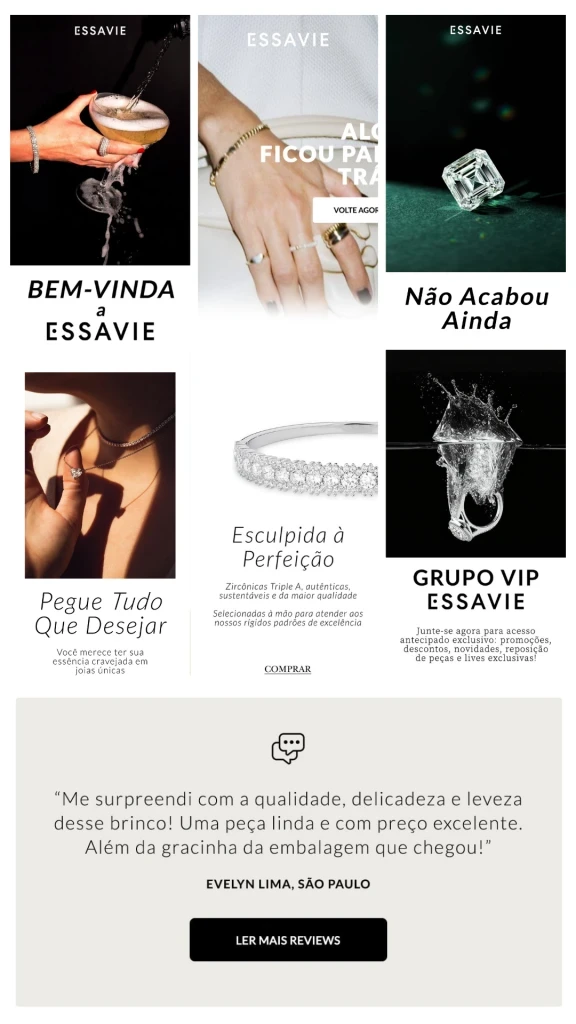
Comunicação automatizada para reduzir ansiedade e gerar recompra.
Comunicação automatizada para reduzir ansiedade e gerar recompra.
O que implementei:
O que implementei:
Fluxo de e-mail: confirmação + cupom de desconto para aproveitar frete → envio → entrega → review → desconto para recompra (7/15/30/45 dias)
WhatsApp Business: suporte proativo
Live chat (Chatra): suporte em tempo real
Fluxo de e-mail: confirmação + cupom de desconto para aproveitar frete → envio → entrega → review → desconto para recompra (7/15/30/45 dias)
WhatsApp Business: suporte proativo
Live chat (Chatra): suporte em tempo real
Resultado:
Resultado:
38% de taxa de abertura de e-mails
21% de recompra em 30 dias
−40% de perguntas repetitivas
38% de taxa de abertura de e-mails
21% de recompra em 30 dias
−40% de perguntas repetitivas
Processo (O que fiz, como fiz)
Processo (O que fiz, como fiz)
PESQUISA
PESQUISA
50+ conversas no WhatsApp/Instagram analisando dúvidas recorrentes
Hotjar: gravações de sessão, heatmaps, pontos de clique
GA4: análise de funil, drop-off, tempo na página
Benchmark: Vivara, Rommanel, Pratafina, marcas indie (Rachel De La Mer)
50+ conversas no WhatsApp/Instagram analisando dúvidas recorrentes
Hotjar: gravações de sessão, heatmaps, pontos de clique
GA4: análise de funil, drop-off, tempo na página
Benchmark: Vivara, Rommanel, Pratafina, marcas indie (Rachel De La Mer)
INSIGHT
INSIGHT
“O ponto de virada foi perceber que os usuários valorizavam mais segurança do que sofisticação visual.”
“O ponto de virada foi perceber que os usuários valorizavam mais segurança do que sofisticação visual.”
WIREFRAME & IDEAÇÃO
WIREFRAME & IDEAÇÃO
As limitações da plataforma me forçaram a testar três estruturas de landing page pré-definidas: hero product, catálogo e storytelling da marca. O hero product venceu.
As limitações da plataforma me forçaram a testar três estruturas de landing page pré-definidas: hero product, catálogo e storytelling da marca. O hero product venceu.
TESTES A/B
TESTES A/B
15+ testes realizados:
15+ testes realizados:
Botão de CTA (“Comprar” vs “Adicionar ao carrinho”)
Posição de reviews (manter vs remover)
Banner de frete grátis (grande vs pequeno vs nenhum)
Upsell (página do produto vs carrinho vs checkout vs pós-compra)
Botão de CTA (“Comprar” vs “Adicionar ao carrinho”)
Posição de reviews (manter vs remover)
Banner de frete grátis (grande vs pequeno vs nenhum)
Upsell (página do produto vs carrinho vs checkout vs pós-compra)
METODOLOGIA
METODOLOGIA
1 semana por teste, mínimo de 1000 sessões por variante.
1 semana por teste, mínimo de 1000 sessões por variante.
Resultados
Resultados
Antes vs Depois (90 dias)
Antes vs Depois (90 dias)
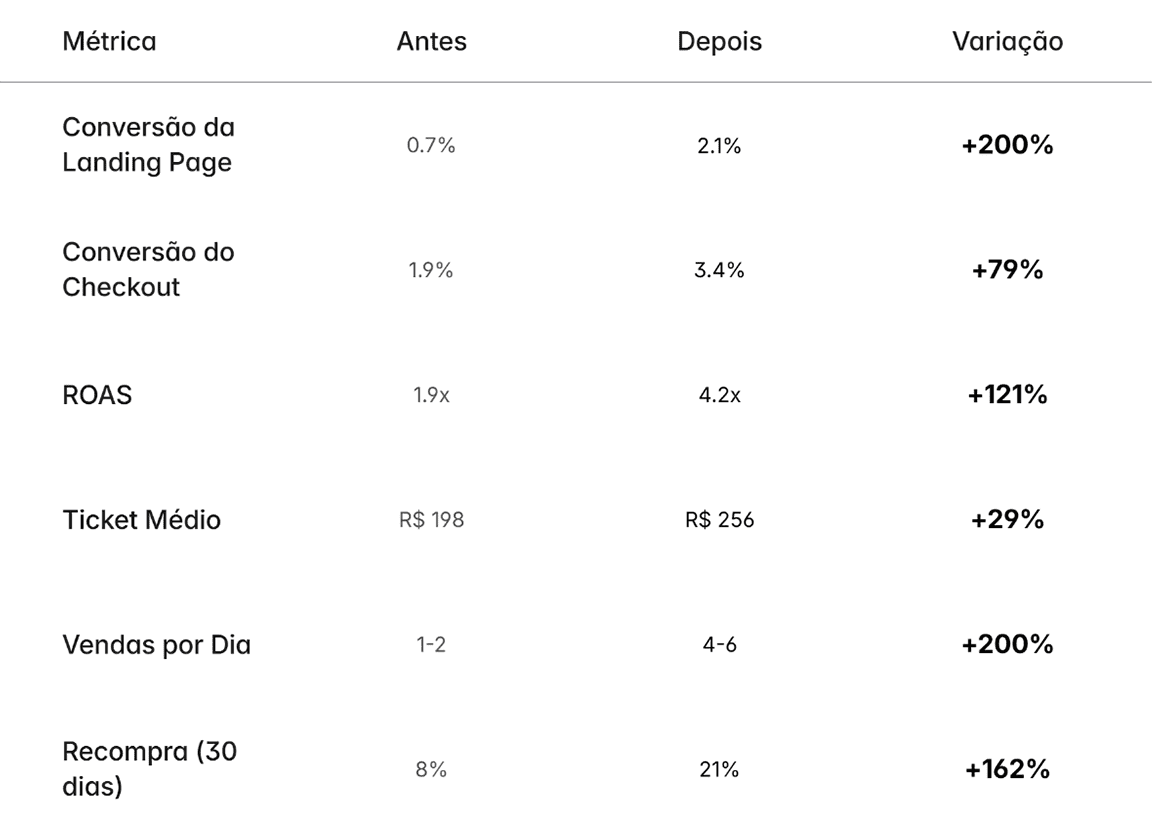
Impacto no Negócio
Impacto no Negócio
~300 pedidos
~300 pedidos
Processados durante o período de crescimento
Processados durante o período de crescimento
~R$75k em receita
~R$75k em receita
Gerados em vendas totais ao longo do projeto
Gerados em vendas totais ao longo do projeto
Break-even atingido
Break-even atingido
Durante a Black Friday
Durante a Black Friday
Pausa estratégica
Pausa estratégica
Operações suspensas no pós-Black Friday e queima de estoque
Operações suspensas no pós-Black Friday e queima de estoque
Aprendizados
Aprendizados
1
1
Clareza >
Sofisticação
Clareza >
Sofisticação
Para compras de ticket médio alto, confiança vem de comunicação clara
Para compras de ticket médio alto, confiança vem de comunicação clara
2
2
Pequenas otimizações se acumulam
Pequenas otimizações se acumulam
Cada melhoria (botão, copy, upsell) foi modesta. Juntas, geraram altos resultados
Cada melhoria (botão, copy, upsell) foi modesta. Juntas, geraram altos resultados
3
3
Teste suas suposições
Teste suas suposições
Eu tinha certeza de que reviews ajudariam. Os testes mostraram o oposto
Eu tinha certeza de que reviews ajudariam. Os testes mostraram o oposto
4
4
Pós-compra faz parte do produto
Pós-compra faz parte do produto
CRM não é “extra”, é parte central da experiência do cliente
CRM não é “extra”, é parte central da experiência do cliente
5
5
Restrições forçam foco
Restrições forçam foco
Orçamento apertado forçou priorização extrema
Orçamento apertado forçou priorização extrema
O QUE EU FARIA DIFERENTE
O QUE EU FARIA DIFERENTE
Testaria a proposta de valor antes do redesign completo
Introduziria sinais de confiança estruturais mais cedo
Isolaria melhor as variáveis nos testes
Exploraria estratégias de preço e kits antes de micro-otimizações
Testaria a proposta de valor antes do redesign completo
Introduziria sinais de confiança estruturais mais cedo
Isolaria melhor as variáveis nos testes
Exploraria estratégias de preço e kits antes de micro-otimizações
POR QUE EU PAUSEI
POR QUE EU PAUSEI
Após a Black Friday, analisei a unit economics (rentabilidade do negócio com base em cada unidade vendida):
Após a Black Friday, analisei a unit economics (rentabilidade do negócio com base em cada unidade vendida):
Para manter o break-even e escalar, eu precisaria de mais de +R$100k em capital OU
Verticalização (produção própria) para melhorar margens
Para manter o break-even e escalar, eu precisaria de mais de +R$100k em capital OU
Verticalização (produção própria) para melhorar margens
Ficou claro que escalar o negócio exigiria capital e riscos operacionais que não faziam sentido para mim naquele momento. Ao mesmo tempo, percebi que o que mais me motivava era resolver problemas de produto, o que me levou a direcionar minha carreira para Product Design.
Ficou claro que escalar o negócio exigiria capital e riscos operacionais que não faziam sentido para mim naquele momento. Ao mesmo tempo, percebi que o que mais me motivava era resolver problemas de produto, o que me levou a direcionar minha carreira para Product Design.
Decisão: aplicar esses aprendizados em produtos mais complexos e escaláveis.
Decisão: aplicar esses aprendizados em produtos mais complexos e escaláveis.
© 2026
Matheus Paiva
© 2026
Matheus Paiva
© 2026
Matheus Paiva