From meeting to action.
From meeting to action.
A 3-day research sprint into why Fireflies.ai was losing users to Granola and why the stated problem wasn't the real problem.
A 3-day research sprint into why Fireflies.ai was losing users to Granola and why the stated problem wasn't the real problem.

Before Getting Started
Before Getting Started
Project context
Project context
This is a speculative case study carried out independently, with no affiliation to or commission from Fireflies.ai. The project was developed under real time constraints, prioritizing research quality and focused solutions over comprehensive coverage. All research was conducted using publicly available sources.
This is a speculative case study carried out independently, with no affiliation to or commission from Fireflies.ai. The project was developed under real time constraints, prioritizing research quality and focused solutions over comprehensive coverage. All research was conducted using publicly available sources.
The Problem
The Problem
What was the challenge given?
What was the challenge given?
The problem came framed as a business concern: Fireflies.ai was losing users to Granola.ai. Churned users reported not knowing which features they had, and described Granola's interface as simpler and easier to navigate. Leadership flagged that new users were taking far longer than expected to activate (LTV), meaning they took too long to reach the product's core value: viewing the summary of a meeting
The problem arrived pre-framed as onboarding and discoverability. The first job was to test that framing, not build inside it.
The problem came framed as a business concern: Fireflies.ai was losing users to Granola.ai. Churned users reported not knowing which features they had, and described Granola's interface as simpler and easier to navigate. Leadership flagged that new users were taking far longer than expected to activate (LTV), meaning they took too long to reach the product's core value: viewing the summary of a meeting
The problem arrived pre-framed as onboarding and discoverability. The first job was to test that framing, not build inside it.

Important nuance
Important nuance
A stated problem is not always the real problem. Users rarely report the root cause accurately, they report the symptom closest to their frustration. The research process was designed to find what was actually happening before any design decisions were made.
A stated problem is not always the real problem. Users rarely report the root cause accurately, they report the symptom closest to their frustration. The research process was designed to find what was actually happening before any design decisions were made.
Research Approach
Research Approach
Understanding the market, the users,
and the product
Understanding the market, the users, and the product
Understanding the market, the users, and the product
Given the 3-day time constraint, traditional user interviews were not feasible at scale. The research was built on three layers: structured desk research across comparison sites and product blogs, a deep qualitative analysis of 25 Reddit thread discussions where real users discuss AI meeting tools spontaneously, and a hands-on exploratory walkthrough of the real Fireflies product.
Given the 3-day time constraint, traditional user interviews were not feasible at scale. The research was built on three layers: structured desk research across comparison sites and product blogs, a deep qualitative analysis of 25 Reddit thread discussions where real users discuss AI meeting tools spontaneously, and a hands-on exploratory walkthrough of the real Fireflies product.
Research decision
Research decision
Why Reddit? Spontaneous comments from users explaining, unprompted, why they switched tools, what broke their trust, or what made them stay are qualitatively equivalent to guerrilla interview data. People don't perform for a forum. They vent, they recommend, they warn. That's the signal.
Why Reddit? Spontaneous comments from users explaining, unprompted, why they switched tools, what broke their trust, or what made them stay are qualitatively equivalent to guerrilla interview data. People don't perform for a forum. They vent, they recommend, they warn. That's the signal.


What the Research Revealed
What the Research Revealed
The moment that made the problem concrete
The moment that made the problem concrete
Alex is a product manager. He just finished a 45-minute stakeholder call. Three decisions were made. Two people committed to deliverables. He was fully present, no notes, because Fireflies was supposed to handle it.
The call ends. He switches to Slack. The summary isn't there. He opens Fireflies. It says "processing." He waits. The window for acting on the meeting is closing, in 10 minutes he has another call.
The summary arrives 14 minutes later. It's long. The action items are vague bullets. He spends 8 minutes editing before sending anything to his team.
The job isn't to transcribe the meeting. The job is to make the 5 minutes after the meeting feel effortless.
Alex is a product manager. He just finished a 45-minute stakeholder call. Three decisions were made. Two people committed to deliverables. He was fully present, no notes, because Fireflies was supposed to handle it.
The call ends. He switches to Slack. The summary isn't there. He opens Fireflies. It says "processing." He waits. The window for acting on the meeting is closing, in 10 minutes he has another call.
The summary arrives 14 minutes later. It's long. The action items are vague bullets. He spends 8 minutes editing before sending anything to his team.
The job isn't to transcribe the meeting. The job is to make the 5 minutes after the meeting feel effortless.
What users are actually saying
What users are actually saying
The research uncovered patterns that went well beyond the stated problem. Several of the most critical findings directly challenged the original framing.
The research uncovered patterns that went well beyond the stated problem. Several of the most critical findings directly challenged the original framing.

Eight behavioral categories emerged from the analysis. The most strategically relevant:
Eight behavioral categories emerged from the analysis. The most strategically relevant:
Bot social friction
Bot social friction
Users avoid tools with a visible bot on external or sensitive calls. Discretion is a feature.
Users avoid tools with a visible bot on external or sensitive calls. Discretion is a feature.
Trust gap in summaries
Trust gap in summaries
Users re-read transcripts to verify what the AI said. This eliminates the time savings the product promises.
Users re-read transcripts to verify what the AI said. This eliminates the time savings the product promises.
Post-meeting action gap
Post-meeting action gap
Summaries are consumed but not acted on. The handoff from "what was said" to "what to do next" is broken.
Summaries are consumed but not acted on. The handoff from "what was said" to "what to do next" is broken.
Billing & trust erosion
Billing & trust erosion
Unexpected AI Credit charges cause emotional disconnection from the product, more than any UX friction does.
Unexpected AI Credit charges cause emotional disconnection from the product, more than any UX friction does.
Synthesis
Synthesis
What we know for sure
What we know for sure
After mapping the research, findings were separated into what was confirmed by multiple independent sources and what remained a hypothesis requiring user validation.
Confirmed, no further validation needed
Confirmed, no further validation needed
Billing trust is the primary documented churn trigger.
Billing trust is the primary documented churn trigger.
Integration failures happen silently, users discover a missing Notion summary hours after the meeting, not in real time.
Integration failures happen silently, users discover a missing Notion summary hours after the meeting, not in real time.
Granola also has critical reliability issues (silent crashes, missed meetings) that rarely appear in its "simpler UI" narrative.
Granola also has critical reliability issues (silent crashes, missed meetings) that rarely appear in its "simpler UI" narrative.
Still questioning
Still questioning
Is the activation delay caused by onboarding friction or by the user simply not having another meeting until days after signup?
Is the activation delay caused by onboarding friction or by the user simply not having another meeting until days after signup?
Is "users don't know features exist" a discoverability problem, or do users see the features and not understand their value?
Is "users don't know features exist" a discoverability problem, or do users see the features and not understand their value?
The most important reframe from the research: users are not churning because Fireflies has too many features. They are churning because they never built a habit around the product before hitting a billing surprise or a silent integration failure. Fixing discoverability without addressing these trust moments would solve the wrong problem.
The most important reframe from the research
The most important reframe from the research
Users are not churning because Fireflies has too many features. They are churning because they never built a habit around the product before hitting a billing surprise or a silent integration failure.
Users are not churning because Fireflies has too many features. They are churning because they never built a habit around the product before hitting a billing surprise or a silent integration failure.
Jobs to be Done
Jobs to be Done
What users actually hire Fireflies to do
What users actually hire Fireflies to do
Six core jobs emerged from the research. Each was framed as a job statement using the structure: I want [motivation] when [context], so I can [outcome].
Six core jobs emerged from the research. Each was framed as a job statement using the structure: I want [motivation] when [context], so I can [outcome].

Exploratory Usability Testing
Exploratory Usability Testing
A first-time user walkthrough before testing with real users
A first-time user walkthrough before testing with real users
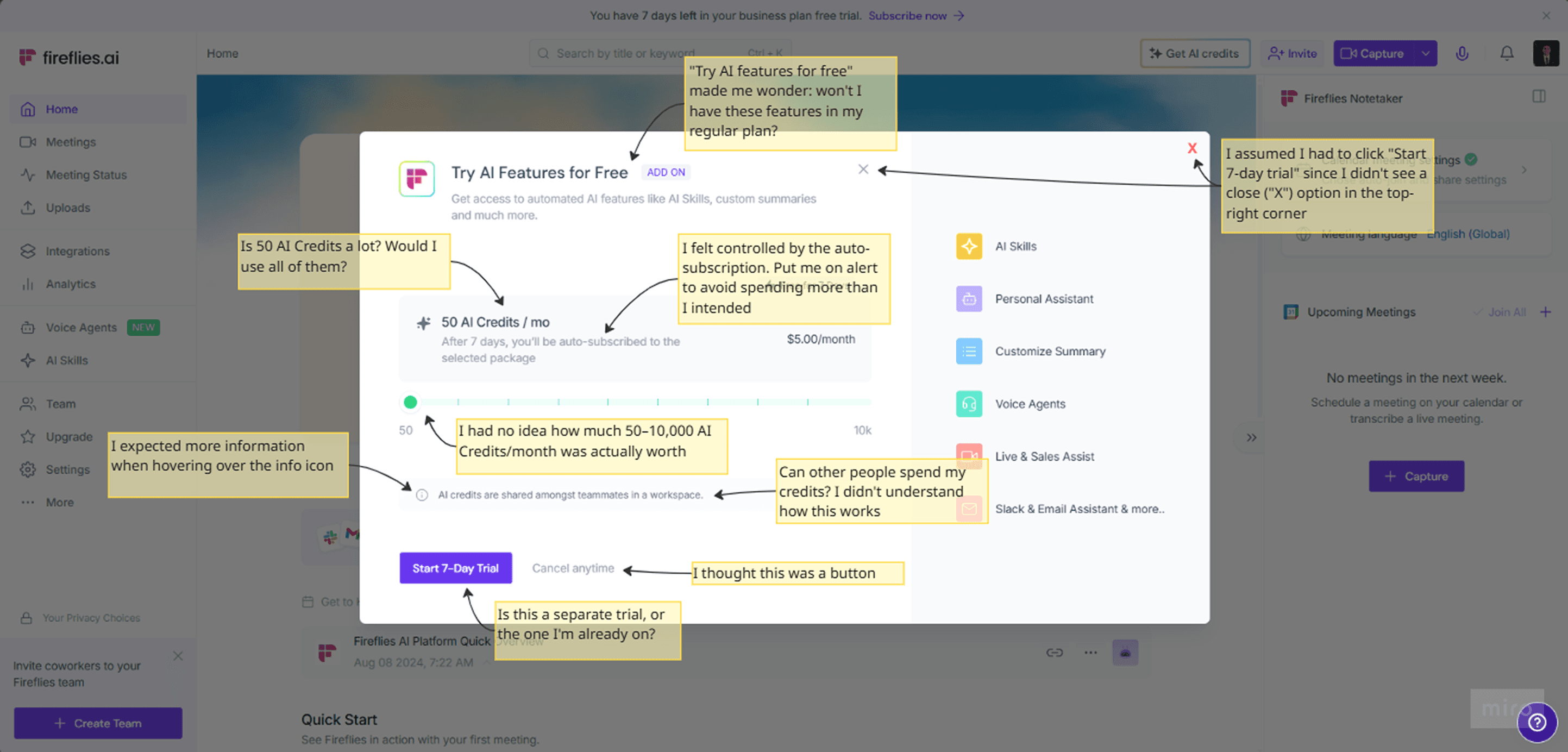
Before wireframing, the jobs and assumptions above were tested directly, by walking through the real Fireflies product as a true first-time user would, from sign-up through a live meeting capture to the generated summary, documenting every reaction in the moment it happened.
Before wireframing, the jobs and assumptions above were tested directly, by walking through the real Fireflies product as a true first-time user would, from sign-up through a live meeting capture to the generated summary, documenting every reaction in the moment it happened.


01
01
Mental model mismatch: the instinct was "create a bot to bring into the meeting," not "add a bot to a live meeting", even after reading the page headline.
Mental model mismatch: the instinct was "create a bot to bring into the meeting," not "add a bot to a live meeting", even after reading the page headline.
02
02
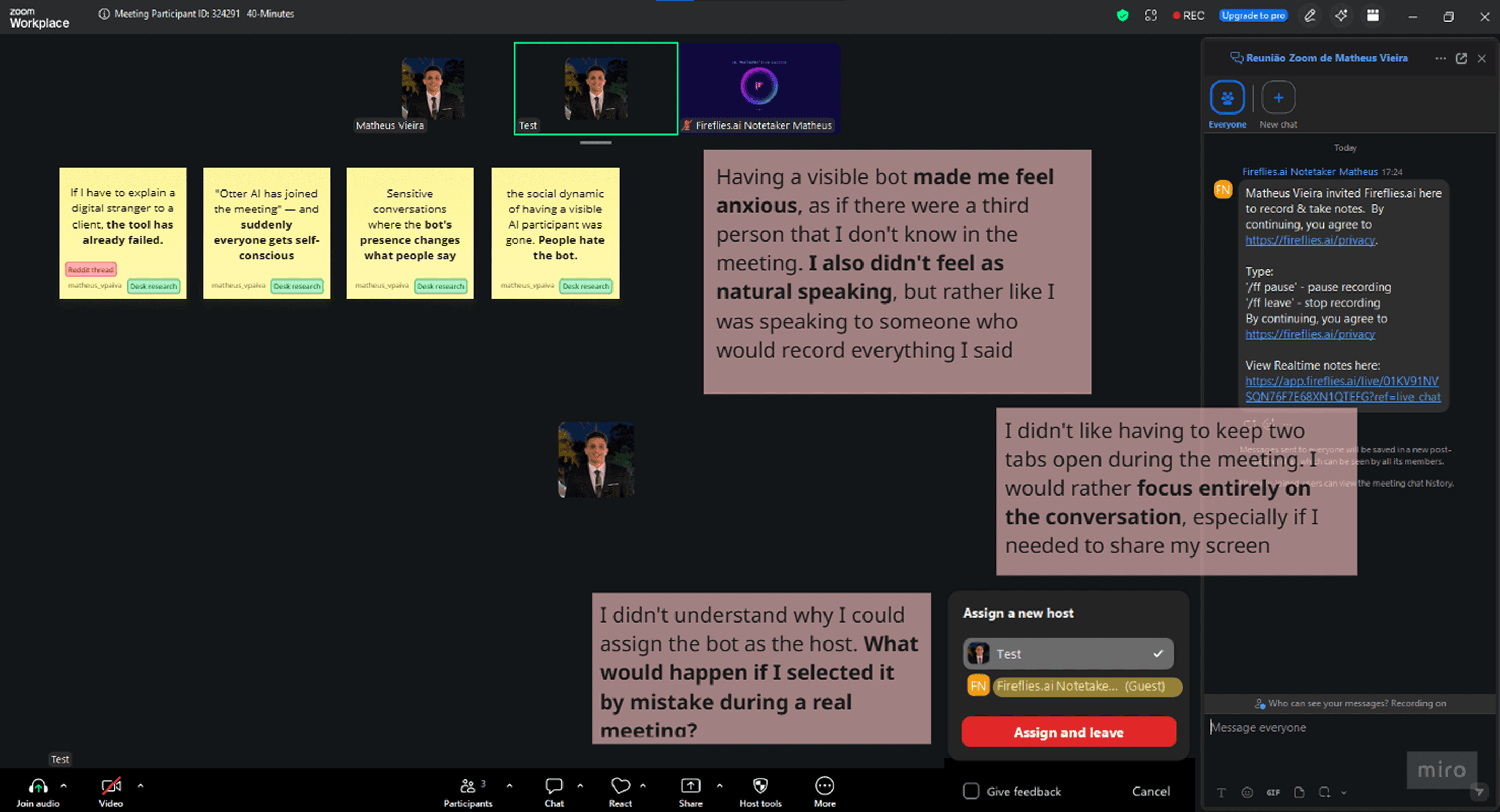
Confirming Fireflies was actually capturing required leaving the meeting entirely to check a separate "Meeting status" tab. Zoom confirmed recording, but not whether Fireflies was.
Confirming Fireflies was actually capturing required leaving the meeting entirely to check a separate "Meeting status" tab. Zoom confirmed recording, but not whether Fireflies was.
03
03
A real misuse risk surfaced: the Fireflies notetaker bot appears as a selectable option in the native "assign new host" dialog, with no warning about what happens if it's picked by accident.
A real misuse risk surfaced: the Fireflies notetaker bot appears as a selectable option in the native "assign new host" dialog, with no warning about what happens if it's picked by accident.
04
04
The recording wasn't visible for ~2 minutes after leaving the call. Long enough to think the entire meeting was lost.
The recording wasn't visible for ~2 minutes after leaving the call. Long enough to think the entire meeting was lost.
05
05
AskFred and AI Skills felt redundant: AI Skills gave thinner output and cost credits; the same ask in AskFred (free, flexible) gave a fuller result.
AskFred and AI Skills felt redundant: AI Skills gave thinner output and cost credits; the same ask in AskFred (free, flexible) gave a fuller result.
06
06
The sidebar navigation was checked directly: there is no cross-meeting search or "ask across all meetings" entry point today. It isn't hidden, it doesn't exist yet.
The sidebar navigation was checked directly: there is no cross-meeting search or "ask across all meetings" entry point today. It isn't hidden, it doesn't exist yet.
Priorization
Priorization
What to solve, and in what order
What to solve, and in what order
Two frameworks, one purpose: figure out what to build, and in what order.
MoSCoW separated must-solve from nice-to-have. Now–Next–Later turned that into a delivery sequence. One deliberate change: search discovery was moved from Next to Now. The reasoning: surfacing Fireflies' strongest retention driver after onboarding means users decide whether to stay before they've seen the reason to. That's a sequencing error, not a feature gap.
Two frameworks, one purpose: figure out what to build, and in what order.
MoSCoW separated must-solve from nice-to-have. Now–Next–Later turned that into a delivery sequence. One deliberate change: search discovery was moved from Next to Now. The reasoning: surfacing Fireflies' strongest retention driver after onboarding means users decide whether to stay before they've seen the reason to. That's a sequencing error, not a feature gap.


User Flow
User Flow
The current broken path vs.
the desired experience
The current broken path vs. the desired experience
The current flow has six failure points between meeting end and first action taken. The redesigned flow collapses that into one continuous experience: meeting ends 🡪 summary pushed in 2 minutes 🡪 60-second read 🡪 action items created in one tap 🡪 search introduced as the bridge to long-term value
The current flow has six failure points between meeting end and first action taken. The redesigned flow collapses that into one continuous experience: meeting ends 🡪 summary pushed in 2 minutes 🡪 60-second read 🡪 action items created in one tap 🡪 search introduced as the bridge to long-term value

The flow also includes an explicit failure branch: "What happens when the recording fails?". A tool that looks like it's working but isn't is more dangerous than one that fails loudly. The failure state was designed with the same care as the success state.
The flow also includes an explicit failure branch: "What happens when the recording fails?". A tool that looks like it's working but isn't is more dangerous than one that fails loudly. The failure state was designed with the same care as the success state.
Wireframes
Wireframes
Six screens, three directions each,
built on the real interface
Six screens, three directions each,
built on the real interface
Six screens, three directions each, built on the real interface
Every wireframe was built on top of real Fireflies UI screenshots, not invented from scratch. That constraint kept every decision grounded: if the solution didn't work in the context of the actual product, it didn't make the cut.
The exploratory test also changed the scope mid-sprint. Two screens were replaced after direct product use revealed more critical issues than the brief had anticipated.
Every wireframe was built on top of real Fireflies UI screenshots, not invented from scratch. That constraint kept every decision grounded: if the solution didn't work in the context of the actual product, it didn't make the cut.
The exploratory test also changed the scope mid-sprint. Two screens were replaced after direct product use revealed more critical issues than the brief had anticipated.
A note on existing features
A note on existing features
Some of the solutions presented here build on functionality that already exists in Fireflies.
The goal of this project was not to identify missing features, but to evaluate whether existing ones were discoverable, understandable, and usable during a real first-time experience. The findings revealed several usability and trust gaps despite the underlying functionality already being available.
Some of the solutions presented here build on functionality that already exists in Fireflies.
The goal of this project was not to identify missing features, but to evaluate whether existing ones were discoverable, understandable, and usable during a real first-time experience. The findings revealed several usability and trust gaps despite the underlying functionality already being available.
Screen 1
Screen 1
Add to live meeting
Add to live meeting
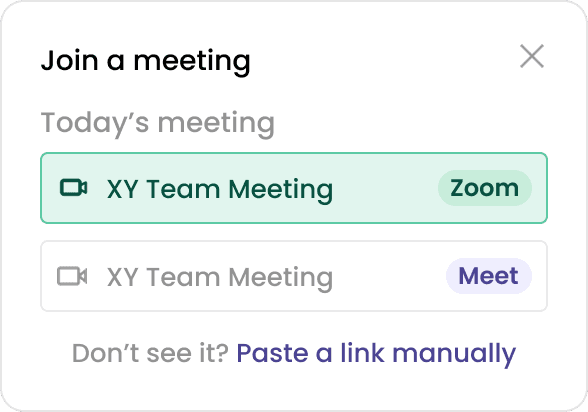
Direction chosen: replace manual link-pasting with calendar-native meeting selection. The failure mode wasn't a bad error message, it was that pasting a link at all was the wrong interaction model. The calendar is already connected. Use it.
Direction chosen: replace manual link-pasting with calendar-native meeting selection. The failure mode wasn't a bad error message, it was that pasting a link at all was the wrong interaction model. The calendar is already connected. Use it.
Screen 2
Screen 2
Live meeting capture status
Live meeting capture status
The anxiety: "Is Fireflies actually recording?" requires leaving the meeting to check a separate tab. This direction keeps status visible inside the call and adds a guard before the bot can be accidentally assigned as host (a real misuse risk discovered during testing).
The anxiety: "Is Fireflies actually recording?" requires leaving the meeting to check a separate tab. This direction keeps status visible inside the call and adds a guard before the bot can be accidentally assigned as host (a real misuse risk discovered during testing).

Screen 3
Screen 3
The post-meeting wait
The post-meeting wait
Direction chosen: repurpose the existing AskFred panel, already in the product, currently underused, as the post-meeting status messenger. No new UI surface needed. The infrastructure exists. The question was whether users would find it there. Testing would answer that.
Direction chosen: repurpose the existing AskFred panel, already in the product, currently underused, as the post-meeting status messenger. No new UI surface needed. The infrastructure exists. The question was whether users would find it there. Testing would answer that.

Screen 4
Screen 4
Summary view
Summary view
The most-cited research finding: in a long transcript, a decision and a topic look identical. This direction adds an explicit "Decisions made / Action items" split above the notes, anchoring the two things users actually need to act on before they read anything else.
The most-cited research finding: in a long transcript, a decision and a topic look identical. This direction adds an explicit "Decisions made / Action items" split above the notes, anchoring the two things users actually need to act on before they read anything else.

Screen 5
Screen 5
AI Skills vs. AskFred
AI Skills vs. AskFred
Two features, same job, different cost. AskFred is free and flexible. AI Skills costs credits and returns thinner output. When a first-time user is given both side by side, they choose AskFred, every time. This direction explores what consolidation looks like when one of the options is clearly dominant.
Two features, same job, different cost. AskFred is free and flexible. AI Skills costs credits and returns thinner output. When a first-time user is given both side by side, they choose AskFred, every time. This direction explores what consolidation looks like when one of the options is clearly dominant.

Screen 6
Screen 6
Search discovery bridge
Search discovery bridge
Cross-meeting search doesn't exist in Fireflies' nav today. It's not hidden, it's absent. This screen proposes two entry points: a standing nav item, and a contextual introduction right after a user's first completed summary. The second matters more: the moment of highest engagement is the moment to show users why staying is worth it.
Cross-meeting search doesn't exist in Fireflies' nav today. It's not hidden, it's absent. This screen proposes two entry points: a standing nav item, and a contextual introduction right after a user's first completed summary. The second matters more: the moment of highest engagement is the moment to show users why staying is worth it.

View all wireframe versions in Figma
View all wireframe versions in Figma
🡭
Next Steps
Next Steps
Where this goes from here
Where this goes from here
01
01
Usability testing with real users. Each screen has three explored directions,the next step is testing them against real users to see which one actually performs, not which one looks best on a board.
Usability testing with real users. Each screen has three explored directions,the next step is testing them against real users to see which one actually performs, not which one looks best on a board.
02
02
Dot voting with the Fireflies design and product team. Where directions are equally defensible, like AskFred-first vs. a fully unified summary surface, the fastest way to align internally before testing is a quick collaborative vote, not a unilateral design call.
Dot voting with the Fireflies design and product team. Where directions are equally defensible, like AskFred-first vs. a fully unified summary surface, the fastest way to align internally before testing is a quick collaborative vote, not a unilateral design call.
03
03
Validate the activation-time metric. Clarifying whether it measures time-to-first-summary or time-to-return-visit remains an open question worth resolving with the product team directly.
Validate the activation-time metric. Clarifying whether it measures time-to-first-summary or time-to-return-visit remains an open question worth resolving with the product team directly.
04
04
Identify retention-correlated behaviors. If product data shows cross-meeting search predicts long-term retention, Screen 6 should be the first concept tested.
Identify retention-correlated behaviors. If product data shows cross-meeting search predicts long-term retention, Screen 6 should be the first concept tested.
View the full research board on Miro
View the full research board on Miro
Briefing · Desk Research · HMWs · JTBD · Usability Test · MoSCoW · User Flow · Wireframes
Briefing · Desk Research · HMWs · JTBD · Usability Test · MoSCoW · User Flow · Wireframes
🡭
Conclusion
Conclusion
What this case set out to prove
What this case set out to prove
A feature existing and a feature working for someone encountering it for the first time are two different claims. This case focused on that gap, not feature gaps, but usability and trust gaps in what was already built.
Every recommendation connects back to a specific observation, a specific finding, or a decision point where one direction was chosen over another and why. That's the standard this project held itself to.
A feature existing and a feature working for someone encountering it for the first time are two different claims. This case focused on that gap, not feature gaps, but usability and trust gaps in what was already built.
Every recommendation connects back to a specific observation, a specific finding, or a decision point where one direction was chosen over another and why. That's the standard this project held itself to.
Existing doesn't always mean usable
Existing doesn't always mean usable
Many of the opportunities identified in this case relate to functionality that already exists. The research showed that a feature existing and a feature working for someone encountering it for the first time are two different claims. Users often struggled to discover, understand, or trust capabilities that were already available.
Many of the opportunities identified in this case relate to functionality that already exists. The research showed that a feature existing and a feature working for someone encountering it for the first time are two different claims. Users often struggled to discover, understand, or trust capabilities that were already available.
From evidence to direction
From evidence to direction
Rather than focusing on feature gaps, this case focused on usability gaps. Every recommendation is tied back to observed behavior, research findings, and tested assumptions, turning insights into clear, testable design directions.
Rather than focusing on feature gaps, this case focused on usability gaps. Every recommendation is tied back to observed behavior, research findings, and tested assumptions, turning insights into clear, testable design directions.
Thank You!
Thank You!
ROLE
UX Designer (solo)
UX Designer (solo)
YEAR
2026
3 days · 2026
TOOLS
Miro · Figma · Claude
Miro · Figma · Claude
SECTOR
AI Productivity / SaaS
AI Productivity / SaaS
© 2026
Matheus Paiva
© 2026
© 2026
Matheus Paiva